
"ज़िन्दगी एक सफ़र है सुहाना, यहाँ कल क्या हो किसने जाना"
Remembering Kishore Da on his birthday....

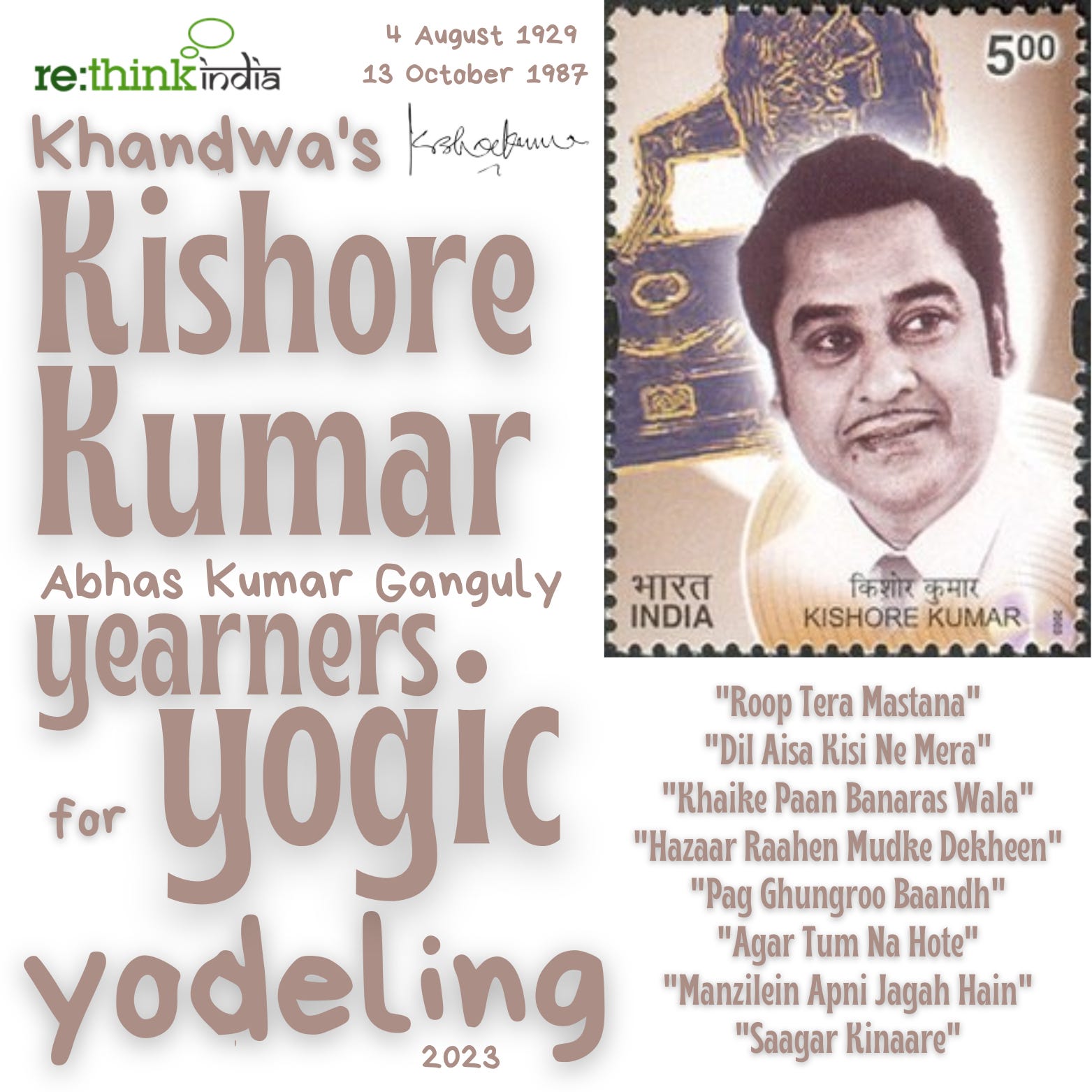
What can be a more befitting tribute to the King of Indian Playback Singing, Kishore Da, than by attempting to engage with his singing style of which yodeling remains the jewel in the crown?
Pick up any one of the 14 Yodeling Songs (as under) or any 1 of the 8 FilmFare Award Winning Songs (as contained in the aforesaid creative); rehearse it well; and do record it in your own voice; upload it on audio.com and send us across the link of the same to editor@rethinkindia.in.
The best attempts to imitate Kishore Da would be recognized on his punyatithi on 13th of October as Kishore Kumar yearners for yogic yodeling 2023.
Do Join the Whatsapp Group at https://chat.whatsapp.com/Dibqd7rX3o4JS22Yso916U to remain connected…
Kishore Kumar’s Top Songs With Yodeling
Nakhrewali — New Delhi (1956)
Panch Rupaiya Barah Aana, and Haal Kaisa Hai Janab Ka — Chalti Ka Naam Gaadi (1958)
Main Hoon Jhum Jhum Jhum Jhum Jhumroo — Jhumroo (1961)
Khawab Ho Tum ya koi Haqeeqat — Teen Deviyan (1965)
Yeh Dil Na Hota Bechara — Jewel Thief (1967)
Tum Bin Jaoon Kahan — Pyar Ka Mausam (1969)
Yeh Shaam Mastani — Kati Patang (1970)
Chala Jata Hoon — Mere Jeevan Saathi (1972)
Zindagi Ek Safar Hai Suhana — Andaz (1971)
Kitne Sapne Kitne Arman — Mere Jeevan Saathi (1972)
Dekha Na Haye Re — Bombay to Goa (1972)
Bhor Aayi Gaya Andhiyara — Bawarchi (1972)
Aise Na Mujhe Tum Dekho — Darling Darling (1977)
Thodi Si Jo Pi Lee Hai — Namak Halal (1982)
Among Kishore Kumar’s manifold talents was yodeling. A unique musical feature that originated from the Alpine region of central Europe, yodeling became more than just a musical device for Kishore Kumar. He adopted it as a form of expression.
Kishore Kumar introduced yodeling to the Hindi Music Industry and remained its primary proponent. It also became his unique identity as it seemed to fit the crests and troughs of his vocal range particularly well.
What is Yodeling?
According to the Dictionary, yodeling is a form of singing or calling marked by rapid alternation between the normal voice and falsetto (high pitch head register).
Yodeling is a feature of folk music in Europe, especially the Alpine region. The origins of the Yodel date back to the middle ages in European history where such an alternating pitch yell was used by shepherds to call out to their cattle or communicate with neighboring mountain villages in the Swiss Alps. Over the course of history, the yodel has appeared in several recorded forms.
In music, it first came to be used in the 1830s. yodeling enjoyed the peak of its popularity in the 1940s. Various forms of odel have originated or been adapted to various parts of the world — from the Swiss Alps to America’s Wild West, Persia, Central Africa, Mongolia, and Mexico.
So how did a form of communication used between cowherds in the Alps of Europe become the signature sound of India’s most loved male singer?
Yodeling and Kishore
According to Kishore’s biography Kishore Kumar: Method in Madness by Derek Bose, Kishore was introduced to yodelling by his younger brother, Anup Kumar, who owned many Austrian music records, where yodeling was a popular vocal technique.
Fascinated, Kishore began listening and practising yodeling until he perfected the art and introduced it in his songs. It was an instant hit. Since Kishore had no professional vocal training, he lent a robustness and unlearnt abandon to his yodeling,
The yodel appeared in many Kishore Kumar songs. Since Kishore was a prolific singer, it’s hard to provide a list of all Kishore Kumar songs with yodeling. So here is a list of the most popular songs of Kishore Kumar where he yodels to perfection.
Kishore Beyond Yodeling
Kishore Kumar may have used yodeling to set himself apart from heavyweight contemporaries like Mohammed Rafi and Mukesh, but yodeling was just a part of his immense talent and the vast canvas of his musical expression. He could kindle romance, elicit pathos, inspire hope, mourn loss, ignite passion, condemn fate and sing of unrequited love in his inimitable style. He brought an element of madness in his fun songs that made them even more enduring.
During a time when even the most talented singers disappear into anonymity after their fifteen minutes of fame, Kishore Kumar accomplished the rare feat of remaining relevant even 30+ years after his death.